Music
The Titanic Violin: A Bandmaster's Last Song, Recovered From the Sea
Wallace Hartley led the Titanic's band in playing hymns as the great ship went down in 1912, and legend held that his violin sank with him. Nearly a century later, the sea-scarred instrument surfaced in an English attic—and after seven years of forensic testing, became the most valuable piece of Titanic memorabilia ever sold.
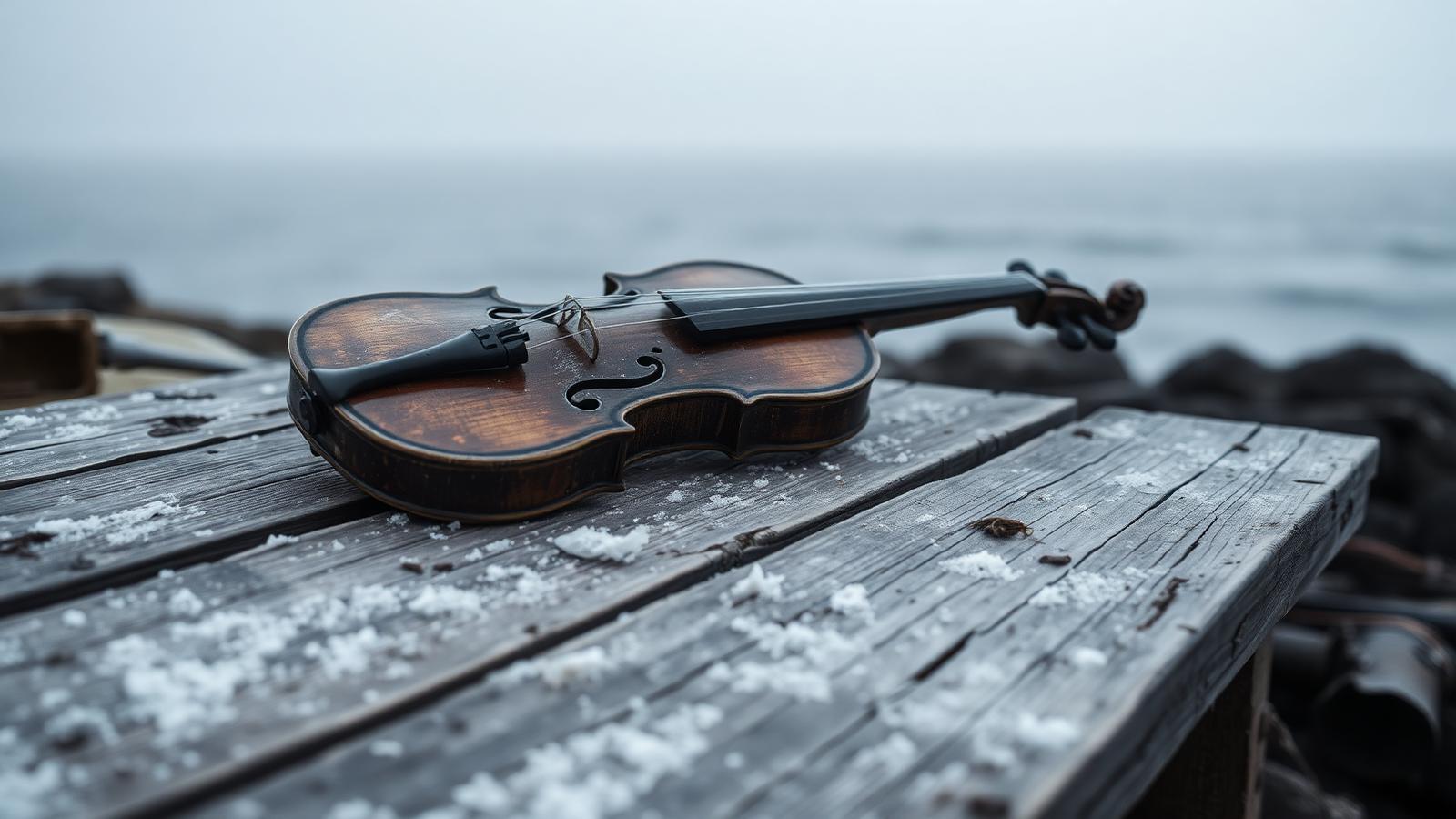
As the RMS Titanic slipped beneath the North Atlantic in the early hours of April 15, 1912, bandmaster Wallace Hartley and his eight musicians famously kept playing to calm the terrified passengers—by lore, closing with the hymn "Nearer My God to Thee." None of the band survived. Hartley, just 33 years old, was among the more than 1,500 who died that night.
The violin Hartley played was no ordinary instrument. It was an engagement gift from his fiancée, Maria Robinson, given in 1910 and engraved on a silver plate at its base: "For Wallace on the occasion of our engagement from Maria". For nearly a century, it was assumed the violin had gone down with the ship, lost forever to the ocean along with its owner.
The reality was quietly remarkable. When the recovery ship Mackay-Bennett retrieved Hartley's body from the Atlantic roughly two weeks after the sinking, the story goes that a leather case initialed "W.H.H." was still strapped to him, buoyed by his cork-and-linen lifejacket. The violin was returned to Maria Robinson, who never married and kept it until her death. From there it passed through several hands before disappearing into obscurity—until 2006, when a man in North Yorkshire found it in his mother's attic and brought it to the Wiltshire auction house Henry Aldridge & Son.
The claim seemed almost too good to be true, and skeptics were fierce. How could a wooden instrument survive prolonged immersion in freezing seawater? Why did the inventory of Hartley's recovered effects make no explicit mention of a violin? A "bitter row" broke out among Titanic historians over the instrument's authenticity. Rather than rush it to sale, the auction house embarked on nearly seven years of painstaking, expensive verification.
The investigation was exhaustive. The auctioneers took the violin to the UK's government Forensic Science Service in Chepstow, which analyzed corrosion and staining and concluded the deposits were "compatible with immersion in sea water," benchmarking them against artifacts recovered from other Titanic victims. A silver expert from the Gemmological Association of Great Britain confirmed the engraved plate was original and its lettering contemporary with 1910 hallmarks. Researchers traced the paper trail of provenance back to Maria Robinson. Finally, in May 2013, a CT scan at a Wiltshire hospital produced 3D images of the instrument's interior, revealing two large cracks and old restoration work consistent with its traumatic history.
In March 2013, the auction house announced its verdict: beyond reasonable doubt, this was Wallace Hartley's violin. Even hardened skeptics were won over—veteran Titanic collector Craig Sopin declared, "I'm a very sceptical person, but I'm convinced beyond doubt". Before it went to sale, the water-scarred, unplayable instrument was displayed at Belfast City Hall, less than a mile from the shipyard where the Titanic was built.
On October 19, 2013, the violin came to auction in Devizes, Wiltshire. Auctioneer Alan Aldridge opened bidding at just £50 against a guide price of £300,000; within minutes bids blew past £100,000, and after about ten minutes the hammer fell at £900,000 to an anonymous telephone bidder—roughly £1.1 million (about $1.7 million) including premium and taxes. It shattered the previous record for Titanic memorabilia—a $356,000 deck plan—to become the most valuable relic ever recovered from the disaster. Today the violin resides at the Titanic Belfast museum, a silent, cracked witness to a bandmaster who played until the very end.